When AI sounds too good
Why a convincing answer can be wrong, and five questions to ask before you trust it.
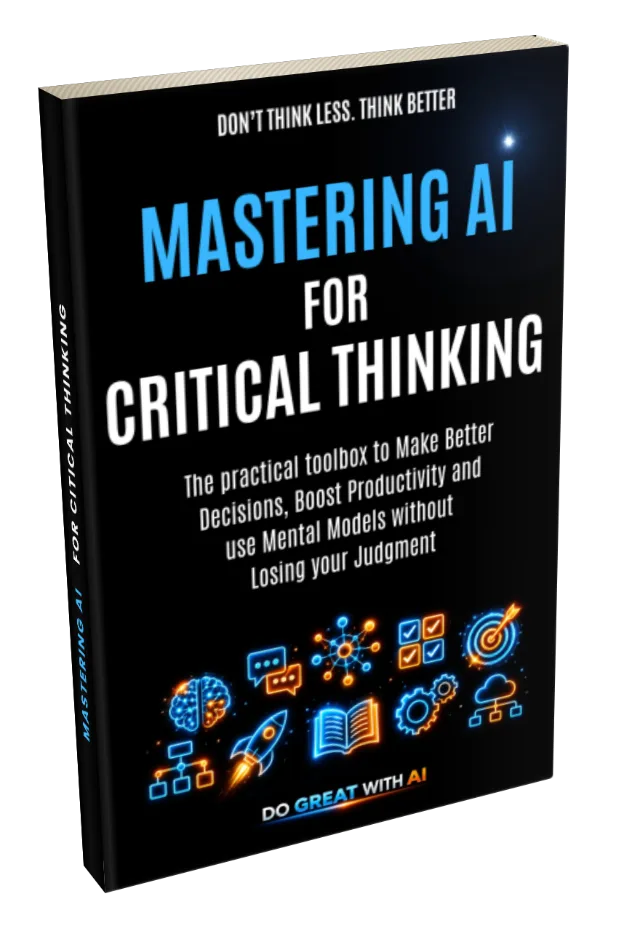
The practical toolbox to make better decisions, boost productivity and use mental models without losing your judgment.
AI answers in seconds, well written and full of confidence. Some answers are excellent; others only look excellent. This book teaches you to tell them apart and to use AI as a thinking partner: to question you, find what's missing and prepare decisions that you then make yourself.
We assume you've opened an AI tool and can hold a basic conversation with it. You don't need to be an advanced user, know how to code or have studied philosophy.
Each chapter includes examples, dialogues, common mistakes, AI practice, exercises and a quick recap. Read it cover to cover or jump to the chapter you need.
Why a convincing answer can be wrong, and five questions to ask before you trust it.
Which decisions deserve your attention and which don't, and the mistake you make when comparing options.
Separate what you know from what you assume, with three columns for your next disagreement.
Turn your AI into Socrates: questions that clarify ideas and test assumptions, without turning it into an interrogation.
Explain it until AI can't confuse you: check whether you understand a topic or just recognize the vocabulary.
Eleven biases, from confirmation to status quo, how you prime AI to agree with you, and a prompt to audit a decision.
Straw man, false dilemma, slippery slope and four more, and how to use AI to spot them in real texts.
Pareto, first principles, inversion, second-order thinking, opportunity cost and other lenses for what you're overlooking.
Criteria, more options, stress tests, pre-mortems and a decision log, with an exercise from start to finish.
Overthinking, AI's proper place and the 30-second pause before you accept an answer.
Think of a real question you're facing: a decision, a work dilemma, an idea you want to test. Write it the way you'd normally ask an AI, for example: "Should I launch this service?"
Don't send it yet. Put it inside this prompt and answer its questions honestly. If you don't know something, say "I don't know".
When you're done, compare your original question with the reframed problem. Has what you need to decide changed? Was a criterion missing? Were you asking for analysis or for permission?
I want to think more clearly about the following question:
[WRITE YOUR QUESTION HERE]

Act as a thinking partner, not as someone who decides for me.
1. Identify the ambiguous terms in my question.
2. Point out the assumptions it seems to contain.
3. Ask me what outcome I want and what constraints I face.
4. Ask only one question at a time.
5. Once you have enough context, respond with:
- available facts;
- interpretations I'm making;
- missing information;
- possible options;
- criteria for comparing those options.
One of the book's 78 prompts. Works in ChatGPT, Claude, Gemini or Copilot.
Scan the QR code at the end of the book, leave your email and they arrive in your inbox.
A practical companion to apply what you've learned without searching through chapters.
All the prompts from the book in one document, ready to copy into your AI: to clarify, compare, spot biases, decide and review.
No. You just need to have used an AI tool before. If you've never opened a chat, the beginners' book is a better starting point: this one doesn't cover signing up or asking your first question.
Socrates, Kahneman and Feynman show up when they help solve a specific problem, and that's it. Every idea is applied to real cases with a prompt and an exercise.
No prompt can guarantee that. What you learn is to spot what's missing, what's being assumed and when to check another source or ask someone who knows more. The decision stays yours.
ChatGPT, Claude, Gemini, Copilot or any other conversational AI. The prompts don't depend on a specific tool.
Available on Amazon in paperback and Kindle. Not using AI comfortably yet? Start with the beginners' book and come back when you use it every day.