Practical AI books

More clarity with AI, without losing your judgment.

Short, practical books for professionals who want to get real value from Claude, Gemini or ChatGPT in their day-to-day work, from AI for beginners to critical thinking. A method to ask well, prompts (instructions for the AI) to copy and exercises to apply what you read. No jargon, no coding.

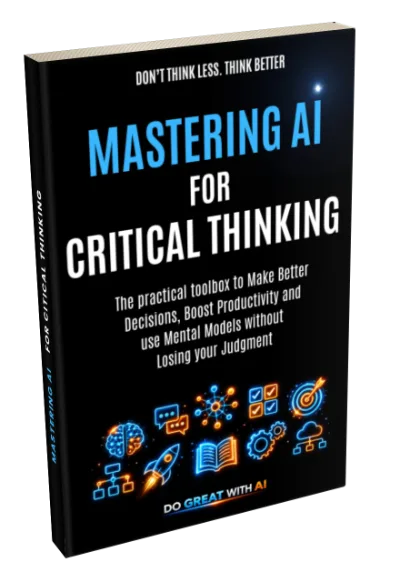
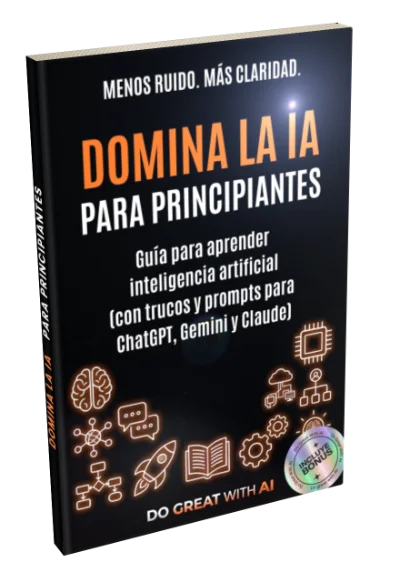
Cover of the Spanish edition, Domina la IA para principiantes Cover of Mastering AI for Critical Thinking

2 books·120 prompts·no coding

Domina la IA para principiantes (Spanish edition): over 40 ratings on Amazon

Sound familiar?

You ask AI something and get an answer anyone could have written.

You've tried it. You ask for an email, a summary or an idea for a project, and you get something correct, tidy and fairly useless. Is the tool the problem? Rarely. What's missing is knowing what to tell it, and what to do with what it gives back.

  • Generic answers

  • Lots of content, little practice

  • Falling behind (or trusting it too much)

The method

You don't need to code or understand how a language model works. You need to know how to ask, how to check and how to decide. That can be learned.

  1. 1

    Learn how to ask AI

    So AI stops guessing what you want and starts working on your case.

  2. 2

    Work with AI

    AI brings speed; you bring what you know about your work.

  3. 3

    Check it and decide

    Before you use an answer, you review it: where does this number come from? What's missing? What if it's wrong? The final call is yours.

What changes

How the way you work with AI changes

Without a method

  • You type one line and accept whatever comes out first.
  • You save other people's prompts that don't fit your case.
  • You read long books on the history of AI that you can't apply.
  • You're not sure whether to trust an answer and don't know how to check it.

With a method

  • You give AI the context it needs and correct it as you go.
  • You understand what makes a good prompt and build your own for each case.
  • You apply each idea with an exercise on a real problem from your work.
  • You check an answer before you use it to make a decision.
The books

Start where you are

Each book solves one specific problem. New to AI? Start with the first one. Already using it every day and want better judgment? The second one.

AVAILABLE ON AMAZON Cover of Mastering AI for Critical Thinking

Mastering AI for Critical Thinking

For people who use AI every day and get tidy, confident answers... that aren't always true. You'll learn to check them, spot biases and fallacies (yours and the machine's) and make decisions with a method.

  • The Socratic method.
  • Spotting biases.
  • Logical fallacies.
  • Mental models.
  • Making better decisions.
  • Boosting your productivity.
  • Same format: explanation, prompt and exercise.

What readers say

Reviews of our Spanish edition on Amazon.es, translated from Spanish.

It's great to finally find a book about artificial intelligence that doesn't waste time telling the history of AI.
Jesús ★★★★★ Verified purchase
I loved it because it doesn't require any prior knowledge. I read it in a weekend, trying out the prompts and examples as I went.
Mercedes G. ★★★★★ Verified purchase
It's not only useful for beginners. Those of us with some experience can also find interesting ideas, tricks and approaches to improve how we use tools like ChatGPT, Gemini or Claude.
astarvp ★★★★★ Verified purchase
It's one of those books that keeps making you think: "I have to try this".
Jess ★★★★★ Verified purchase
I tried interesting things as I read it and started getting results without spending many hours on it.
Miguel ★★★★★ Verified purchase

Read all reviews on Amazon.es (in Spanish)

Frequently asked questions

Which AI book should I read if I'm starting from scratch?

Master AI for Beginners. It's written for people who have tried ChatGPT, Gemini or Claude and got weak answers: it starts with a prompt to copy, helps you set up your first AI and teaches you a five-part formula (role, context, goal, instructions and format) to ask well.

Do I need to be technical or know how to code?

No. You work with AI by writing in plain language. If you can explain a task to a colleague, you know enough to start. Master AI for Beginners goes step by step from your first prompt.

Who is Master AI for Beginners not for?

If you're looking for a technical course, want to learn to code or build agents, it's not your book. Nor is it if you don't use a computer at work: the examples come from office work, management and projects.

I already use ChatGPT. Will it help me?

Yes. Using AI and working well with it are different things, and several reviews come from readers who already used it and now get better answers. If you use it every day and your concern is whether to trust what it says, take a look at Mastering AI for Critical Thinking.

There are thousands of free prompts. What does a book add?

Loose prompts get forgotten or don't fit your case. The book teaches you the logic to build your own and to fix them when the answer doesn't work. We give you example prompts and you'll learn to adapt them to your case.

Does it work with ChatGPT, Gemini, Claude or Copilot?

Yes. The method works with all of them and doesn't depend on any specific tool.

How do I get the bonuses?

At the end of the book there's a QR code that takes you to a page where you leave your email. The first email has the bonuses.

Where can I buy the books?

Mastering AI for Critical Thinking is available on Amazon in paperback and Kindle. The English edition of Master AI for Beginners is coming soon; if you read Spanish, Domina la IA para principiantes is available on Amazon.com. Questions? Write to info@dogreatwithai.com.

What if it's not for me?

Our books are sold on Amazon, so returns are handled by Amazon under its own terms.

Photo of the author behind Do Great With AI

Who is behind Do Great With AI

Behind Do Great With AI are 25 years of engineering on international projects.

  • Designing automation and control systems.
  • Leading multicultural teams on large engineering and construction projects.
  • Currently, assessing AI opportunities in business: what problem they solve, how they fit into existing processes and what value they create.

That experience shapes every book: value appears when something answers a real need and gets used day to day.

That's why I don't write about theory and focus on how to apply AI in practice.

AI won't think for you. It can help you think better, if you know how to use it.

Your AI can do much more.

Start with the book that fits you: from your first prompt to deciding with judgment.